(i:)About the project Thirteen drawings that move by arithmetic. Each study puts one figure on a grid of 12 px and hands it to a clock: once per second a rule is applied and the drawing jumps to its next state, with no easing and nothing animated for its own sake. Every position can be derived from the number on the clock, and every rule is printed beside the plate it moves, with its live values.
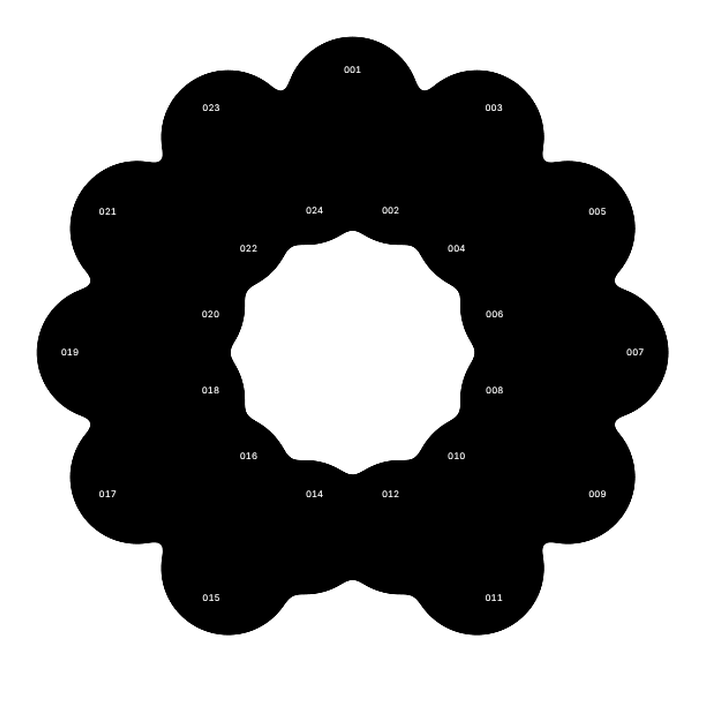
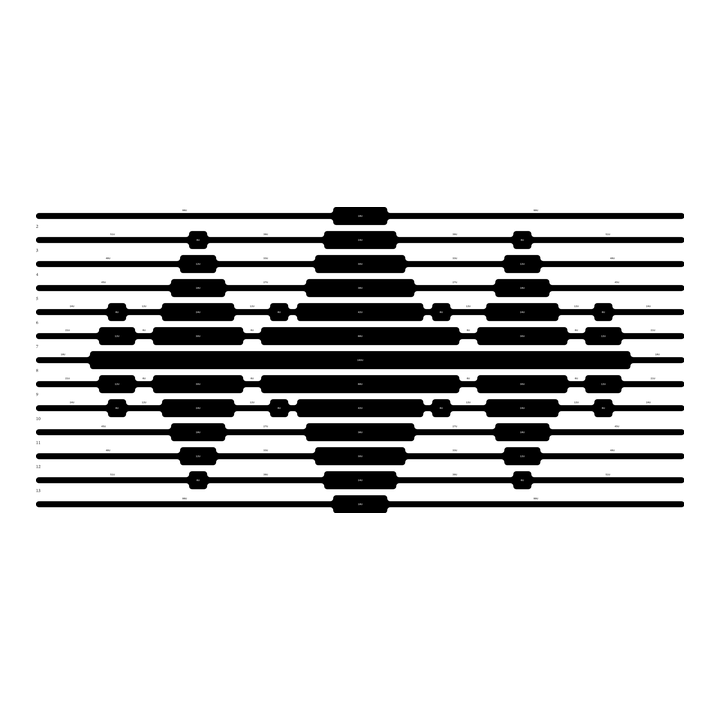
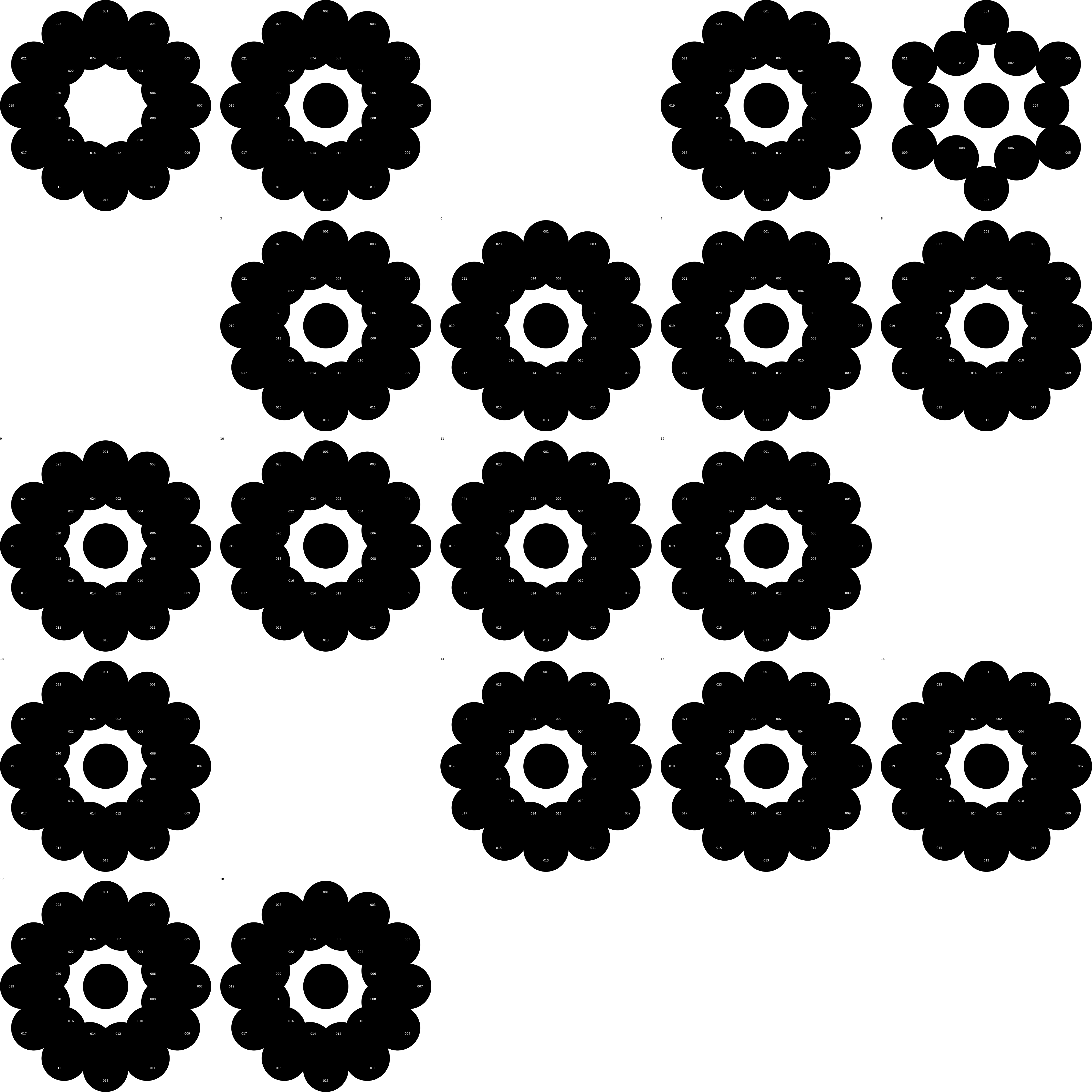
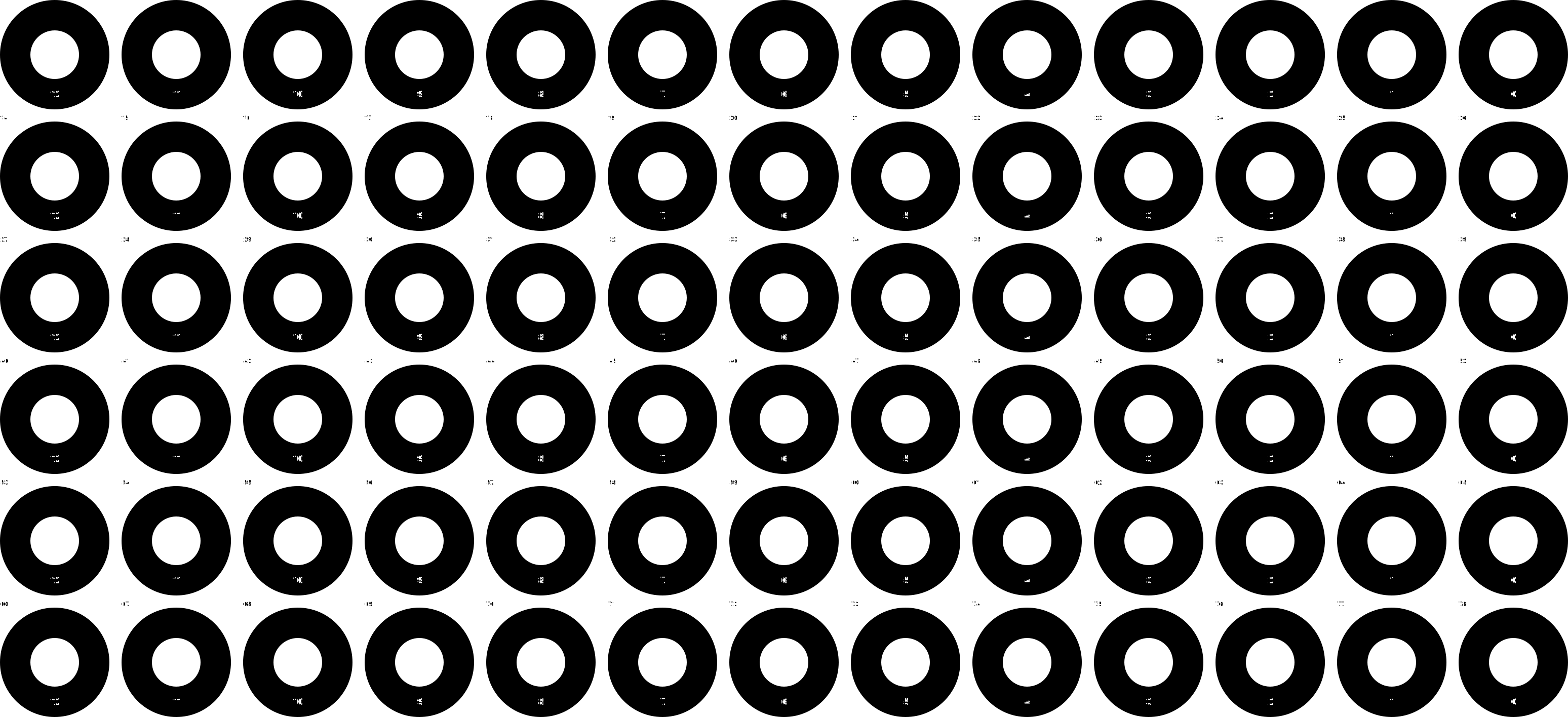
Eighteen rings in six rows of three. Every ring has twenty four stations, fifteen degrees apart, the even ones on an outer orbit and the odd ones on an inner one. A bead either stands on a station or does not, so each ring is a word of twenty four bits, and each second every ring rewrites its word by its own rule.
The first five rings only open and turn: a gap that walks round the ring one station a second, an inner orbit that swings fifteen degrees back and forth, an eclipse whose window grows by one bead on each side per second along a triangle wave, an alternation in which every bead changes orbit every second, and a gate that opens at top and bottom at once. The rest compute: Fourier modes with one to twelve lobes, two doors and four gates on the same triangle wave, two windows that travel against each other and meet every twenty four seconds, two combs that make a moiré, Bjorklund's even distribution of n beads over twenty four stations, Thue–Morse, the numbers coprime to n, the quadratic residues modulo seven primes, two openings breathing at 12 and 8 seconds, the Josephus elimination that leaves station 16, a scattered walk of mirrored pairs and the doubling map modulo 25, which lights twenty stations because 2 is a primitive root.
Almost every rule depends only on the distance of a station from the top, so station k and station 24 − k always agree and the rings are symmetric, with two deliberate exceptions, Josephus and doubling, which run round the ring in one direction. Beneath each row a line prints the rule and its current value.
Itwenty four stations Every ring has 24 stations, 15° apart, numbered from the top. The even stations lie on the outer orbit and the odd ones on the inner, so a full ring is 24 beads and every figure is a subset of those 24: a word of 24 bits that changes once a second.1 Most rules depend only on m, the distance of a station from the top, 0 to 12. Station k and station 24 − k always agree, so the figures are symmetric left to right, and the plate is really a set of words of 13 bits.
IIopenings Gap moves a single absence round the ring, one station per second. Breath and Alternate swap between two states every second. Eclipse, Gate, Doors and Quarters open one, two, two and four windows that widen by one bead each side per second along a triangle wave n = 6 − |6 − (t mod 12)| and close again; Cascade runs two such windows at 12 s and 8 s, so it repeats only after 24 s.2 Beats moves two windows of three beads in opposite directions at 15° per second: they cross at the bottom after 12 s and meet at the top after 24 s.
IIIarithmetic on the ring Harmonic keeps the stations where cos(h·θ) ≥ 0 for h = 1 … 12, so it shows h lobes. Sieves sets two combs of period s turning against each other; where their teeth coincide the ring shows a moiré. Euclid spreads n beads over 24 stations as evenly as possible, the gaps never differing by more than one. Thue–Morse lights m + t where its binary digits have an even sum.3 Coprime keeps the m that share no factor with n, Residue the m that are squares modulo a prime p, and in both about half the ring survives. Josephus removes every second bead still standing until only station J(24) = 16 is left. Scatter toggles the pair (7t + 3) mod 13, a walk through all thirteen positions. Doubling lights 2ⁱ mod 25, and since 2 is a primitive root modulo 25 it reaches 20 stations before it closes.
IVperiods The rings repeat after 2, 6, 12, 21, 22, 23, 24 and 26 seconds; Thue–Morse never repeats, because its sequence is not periodic. Two of them, Josephus and Doubling, run round the ring in one direction and break the mirror symmetry on purpose.4 Under every row a line prints each rule with its current value, so any ring can be checked against its formula.
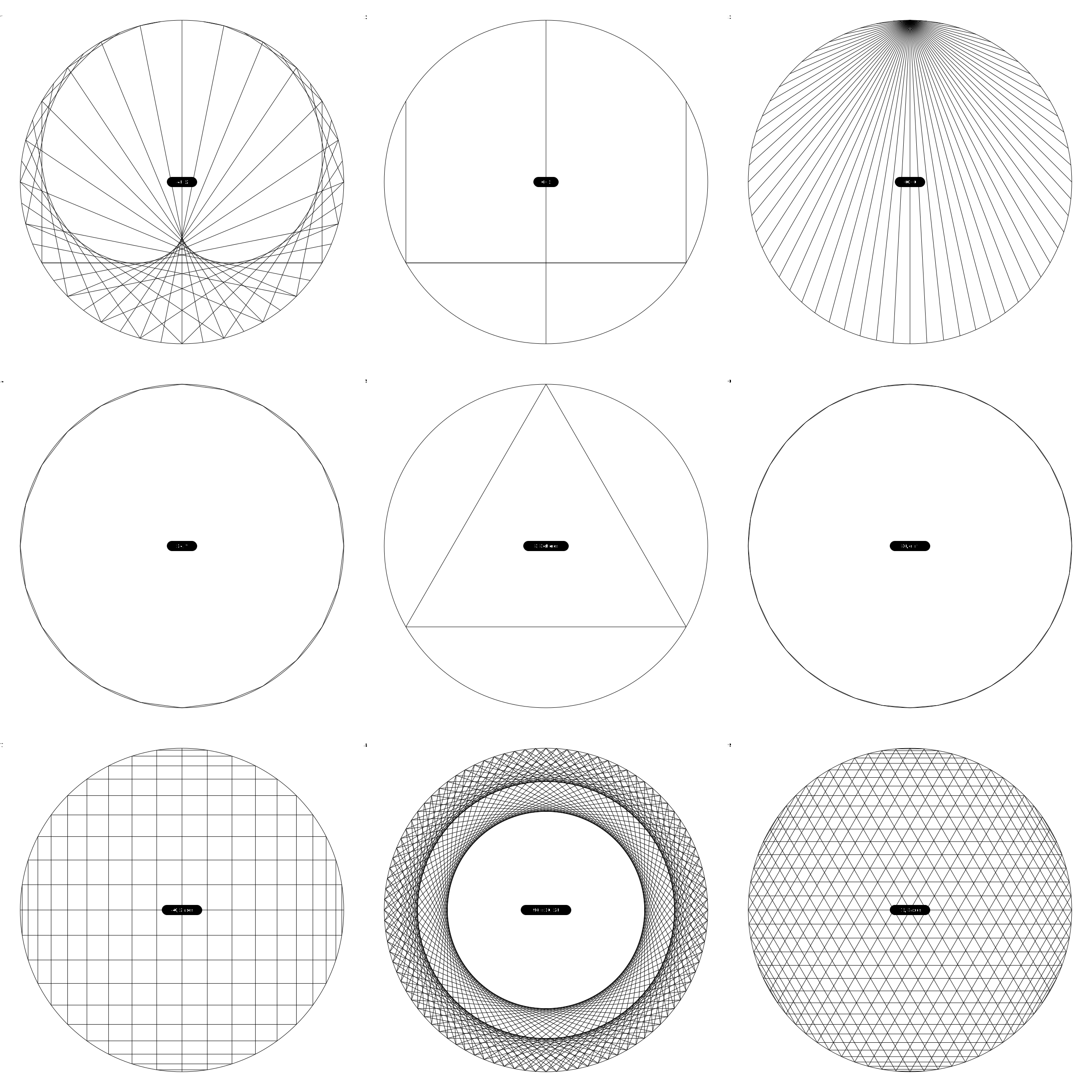
Nine circles. Round each one n points are placed evenly and numbered from the top, and from every point k a straight chord goes to another point f(k) given by a rule. No curve is ever drawn; where many chords crowd together their envelope appears, a curve that none of them is.
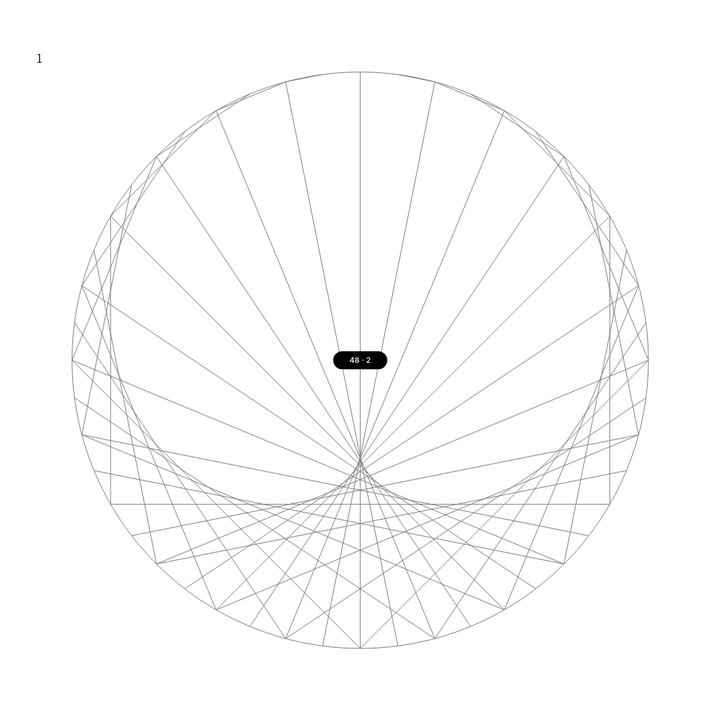
The top row multiplies: k goes to k × m modulo n. For m = 2 the envelope is a cardioid, for 3 a nephroid, and for every multiplier m an epicycloid with m − 1 cusps. Cusps keeps 48 points and steps m from 2 to 11, one per second, so the cusps multiply. Resolution keeps m = 2 and adds six points per second, 6 to 72: the rule stays the same, only its sampling gets finer. Multipliers runs every multiplier from 0 to 59 on sixty points: m = 0 sends every chord to one point, m = 1 joins every point to itself and draws nothing, and m = 59 = −1 mirrors the circle onto itself.
The middle row adds. In Stars k goes to k + m on 24 points, the star polygon {24/m}, which falls apart into gcd(m, 24) separate polygons whenever m shares a factor with 24. Complete adds a point per second and joins every pair, the complete graph Kₙ with n(n − 1) / 2 chords, so the count climbs along the triangular numbers to 276. Distances adds one chord length per second until all C(36, 2) = 630 chords of 36 points are drawn.
The third row reflects. k goes to c − k, and every chord of such a family is parallel to every other. Since the points are equally spaced in angle, not in height, the parallels crowd towards the rim, as cos does near its maximum. In Globe two families at right angles make a sphere seen from the front, denser every second. In Tunnel two chord lengths on 96 points each touch their own inner circle of radius R · cos(πs / 96); as s grows one circle closes and the other opens. Mesh lays 1, 2, 3 and up to 12 families over each other, through the divisors of 72, until 432 chords form a mesh.
Ithe rule n points are equally spaced on a circle and numbered 0 to n − 1 from the top. Point k is joined by a straight chord to point k·m mod n. No curve is ever drawn; where many chords crowd together their envelope appears, a curve that no single chord contains.1 Every figure is a list of pairs (k, f(k)) computed fresh each second, so the plate is nine functions on finite circles.
IIcusps The envelope of the chords for multiplier m is an epicycloid with m − 1 cusps. For 2 it is the cardioid, for 3 the nephroid. Cusps steps through these once per second, so the number of cusps rises by one each time.2 Every figure is symmetric about the vertical axis through point 0, because k and −k are sent to m·k and −m·k.
IIIresolution Resolution keeps m = 2 and adds six points per second. With six points the figure is a few lines; with seventy two the cardioid is unmistakable. The curve does not change, only how much of it the eye can reconstruct.3 Cusps and Resolution together separate the two things that make the picture: the rule and its sampling.
IVadding instead of multiplying Stars joins k to k + m. On 24 points this is the star polygon {24 / m}: a 24-gon for m = 1, a star for m = 5, 7 or 11, and for m with a common factor with 24 a compound of several polygons, as many as the gcd. Complete adds a point a second and joins every pair, so the chord count climbs along the triangular numbers. Distances adds one chord length per second until all 630 chords of 36 points are drawn.4 Each centre prints its parameters, so any chord can be checked by counting points. Globe, Tunnel and Mesh join k to c − k: all chords of one family are parallel, and because the points are equally spaced in angle the parallels crowd towards the rim, so two families at right angles read as a sphere, two chord lengths as a tunnel, and twelve families as a mesh of 432 chords.
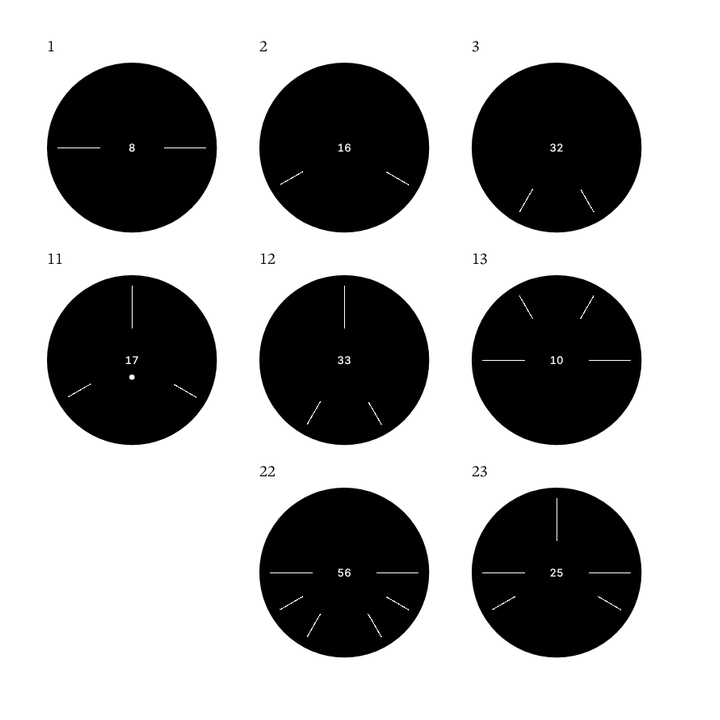
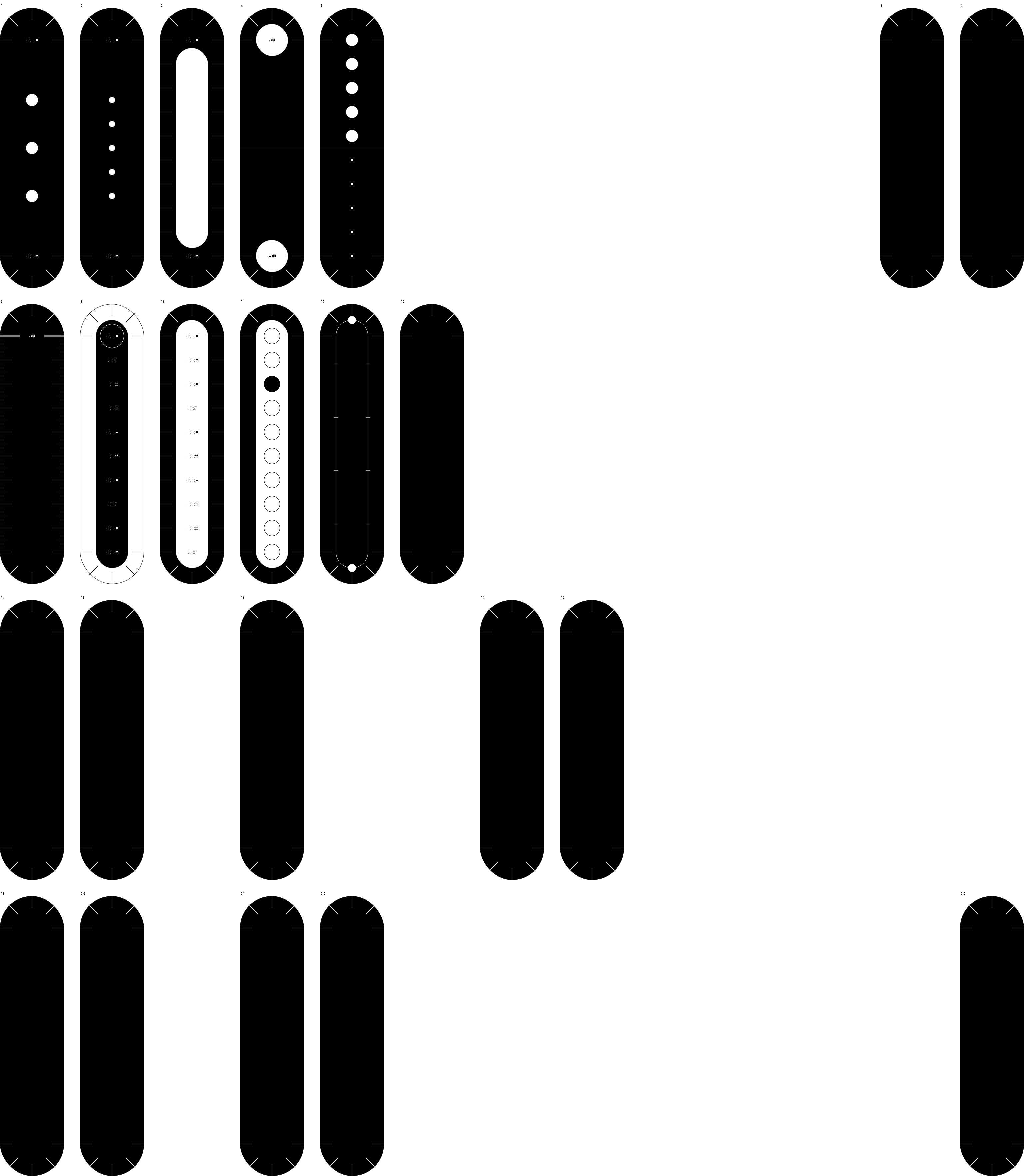
Twenty three capsules, one variable. Every capsule computes a function of t, the seconds since the page opened, and shows the result. Nothing else enters: no randomness, no memory beyond t itself. Each second t grows by one, every capsule takes one step of its rule and holds, so the whole plate is a table of twenty three functions evaluated at the same number.
The first row moves quantities: a remainder t mod 3 that walks, a belt of five places, a column that loses six units a second, two lengths that close on each other in four equal steps, and a triangle wave that fills and empties a glass. After the gap, the number ten is cut in two parts that always add up, then into all thirty six ways of three. The second row reads the clock: a needle and a ring driven by the same triangle wave, the time written backwards, a jump of seven that visits all ten places because 7 and 10 are coprime, and two discs stepping three and four that meet only every ten seconds. The third row counts and adds: a soroban digit, the sum of two remainders, the squares as sums of odd numbers, then a row of Pascal's triangle and Zeckendorf's unique sums. The fourth row divides and iterates: Euclid's algorithm by subtraction, prime factors, then procedures that always settle, Kaprekar's 6174, happy numbers that reach 1 and Newton's square root, which doubles its correct digits at every step.
Every capsule prints the value it is showing, so each drawing can be checked as arithmetic.
Ione integer Every capsule is a function of t and of nothing else. Two readers who open the page in the same second see the same plate, and anyone can predict any capsule at any second with pencil and paper.1 The clock c = 33:30 + t is the same number written as minutes and seconds. The Ledger prints c, c − 1, c − 2 down the column, so it reads the clock backwards.
IIfour kinds of function Remainders, t mod n, run forward and jump back: the Pulse, the Belt, the Drain, the Abacus. Triangle waves, n − |n − (t mod 2n)|, run forward and then back again without a jump: the Ruler, the Picker and the Hourglass.2 Products modulo ten step by a fixed amount: 7t + 2 in Beads, 3t and 4t in LCM. Recursions take the previous value and transform it: Euclid subtracts, Kaprekar sorts and subtracts, Newton averages.
IIIperiods Each capsule repeats after its own period: 3 s for the Pulse, 5 for the Belt, the Pincer and the Adder, 8 for the Drain, 10 for the Hourglass, Beads, the Orbit, LCM, the Abacus and Pascal, 18 for the Ruler and the Picker. Together these return to their opening state only after lcm(3, 5, 8, 10, 18) = 360 seconds.3 The sequences run longer: 36 compositions of ten, 98 numbers to factor and 144 Zeckendorf sums.
IVsmall proofs Beads jumps by seven on ten rings and hits every ring once in ten seconds, because gcd(7, 10) = 1. In LCM the two discs differ by t mod 10, so they meet exactly when t is a multiple of ten.4 Squares is an identity drawn as a stack: 1 + 3 + … + (2n − 1) = n². Kaprekar reaches 6174 in at most seven steps from any four digits that are not all equal, and Newton squares its error at every step.
One number, written six times. Each row is a place value system with thirteen places: base 2 at the top, then 3, 4, 8, 10 and 16. The rightmost place counts units, the next one b, then b², and so on up to b¹². An empty place carries only its index, 12 on the left to 0 on the right, so before anything is written the plate shows pure capacity: seventy eight places that could hold a number up to b¹³ − 1. Each index turns with its disc: a place holding the digit d stands d / b of a turn clockwise from the bottom, so a binary one carries its index to the top and a hexadecimal place moves 22.5° per unit. The indices wake one per second, from the top right place leftwards and row by row, so after seventy eight seconds every index is turning.
The number grows by the Fibonacci rule: every second the new value is the sum of the two before it, 1, 1, 2, 3, 5, 8, 13, 21 … Each step multiplies it by about φ ≈ 1.618, so its length grows at a constant rate, but the rate depends on the base: a new place opens every 1 / log_b φ steps. Binary needs a new digit every 1.44 steps and is full at n = 19, when F(19) = 4181 passes 2¹². Ternary fills at n = 30, quaternary at 37 and octal at 54, the last term. Decimal and hexadecimal never fill. A full row keeps F(n) mod b¹³, the last thirteen digits of a number that no longer fits.
At n = 54, F(54) = 86 267 571 272: eleven decimal places and ten hexadecimal ones, so five places of the plate are never written. Six seconds later the cycle starts again from a single 1, so one cycle is a minute. A place that changes is marked for a quarter of a second, which makes the carries visible: early on only the units change, near the end an addition rewrites almost every place at once.
Icapacity before content With thirteen places, base b can hold every number from 0 to b¹³ − 1. Binary stops at 8191, decimal at 9 999 999 999 999, hexadecimal at about 4.5 quadrillion. At n = 0 nothing is written and every place shows only its index, the power of b it would count.1 The six rows are six answers to one question: how much room the same quantity needs in a given base.
IIgrowth by addition From n = 1 the plate writes F(n), one term per second. Since F(n) ≈ φⁿ / √5, the number of digits in base b grows like n · log_b φ, a straight line whose slope is the logarithm.2 So a new place opens every 1 / log_b φ steps: 1.44 in base 2, 2.28 in base 3, 2.88 in base 4, 4.32 in base 8, 4.78 in base 10 and 5.76 in base 16. Base 4 runs exactly half as fast as base 2, because one quaternary digit is two binary digits, and base 8 a third as fast.
IIIrows that fill Binary is full at n = 19, ternary at n = 30, quaternary at 37 and octal at 54: these are the first n with F(n) ≥ b¹². From then on a row shows F(n) mod b¹³, the last thirteen digits, and they keep changing although the number no longer fits.3 The marked places show the carries. Adding two small numbers changes only the last digits; adding two large ones rewrites almost every place, so late in the cycle whole rows change in a single second.
IVthe cycle At n = 54, F(54) = 86 267 571 272: eleven decimal digits and ten hexadecimal ones, so two places of base 10 and three of base 16 are never written. The plate holds for six seconds and starts again from 1, so one cycle lasts 60 seconds.4 Under the plate each row is also printed as a string, so every place can be checked against its digit.
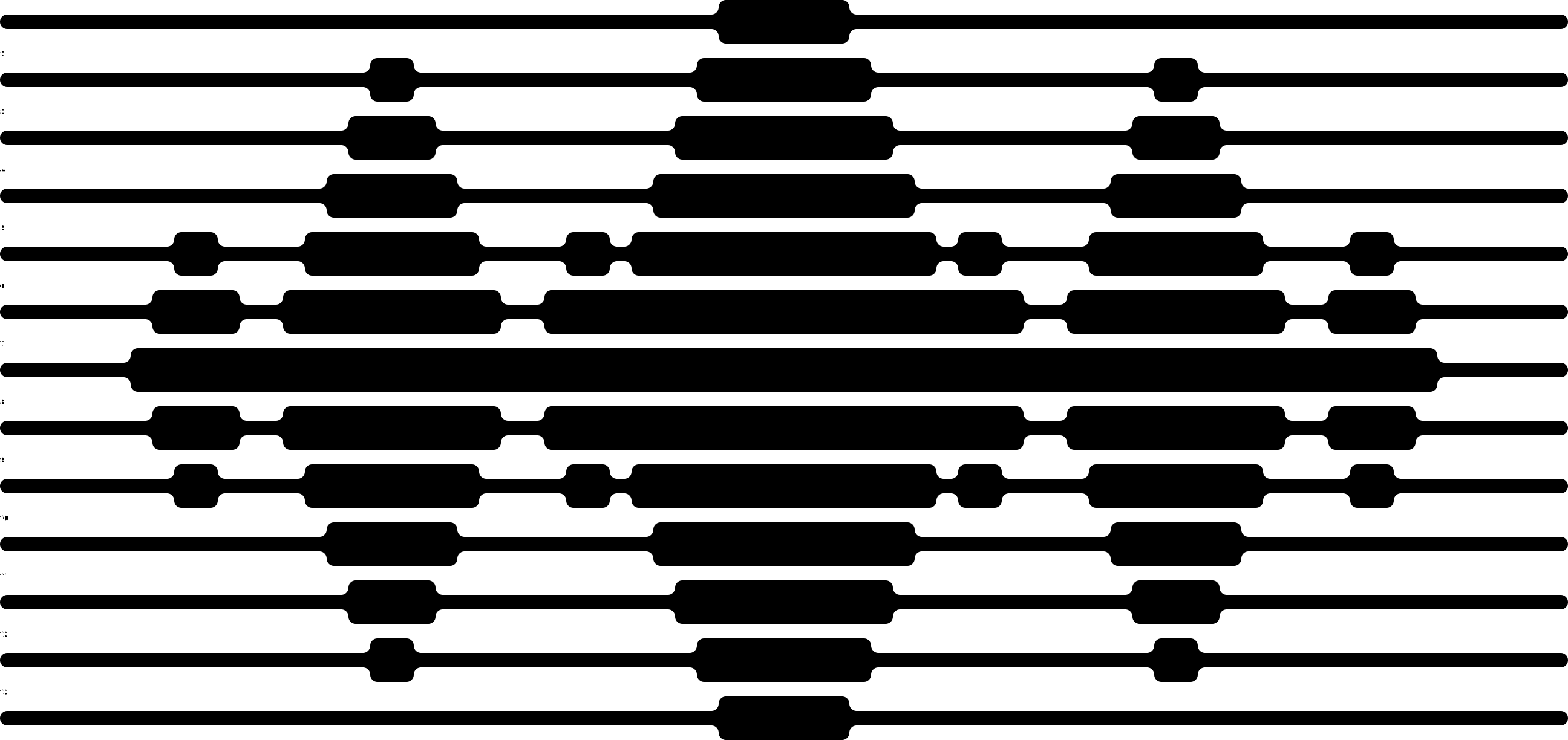
Thirteen rows of 216 cells each. A row starts empty. One second into the cycle a seed appears at cell 108, the middle of the middle row. Three seconds later two more appear at 54 and 162, the middles of the two halves, then four at the middles of the quarters, then eight, then sixteen. Each new level halves the gaps that remain, so after five levels 1 + 2 + 4 + 8 + 16 = 31 seeds divide the row into 32 equal parts.
Every seed grows three cells to each side per second. A seed of level L starts at second 3L, so the old pieces are long and the new ones short, and halfway through a row reads like a ruler with marks of five lengths. When two pieces touch they merge into one. The smallest gaps close first and the oldest last, and about fifteen seconds after its first seed the row is a single piece of 216 cells. The numerals print the length of every piece and every gap, and they always add up to 216.
Row k runs the same programme |k − 6| seconds after the middle row, so the filling spreads across the plate from the centre in a diamond, one row per second, and about twenty one seconds in every row is full. Then the programme runs again on the full rows: the same seeds, in the same order, cut the pieces back apart, the middle row first, until at forty eight seconds every row is empty and the cycle begins again.
Iseeds by halving A row is 216 cells long. The first seed stands at 108, the middle. Three seconds later two more stand at 54 and 162, the middles of the two halves; then four at 27, 81, 135 and 189; then eight; then sixteen. Level L adds 2ᴸ seeds at (2j + 1) · 216 / 2ᴸ⁺¹, so after five levels 1 + 2 + 4 + 8 + 16 = 31 seeds cut the row into 32 equal parts of 6.75 cells.1 Every new level lands exactly in the middle of the gaps that remain, so the empty length is halved again and again.
IIgrowth and merging A seed of level L starts at second 3L and from then on grows three cells to each side per second: its half width is r = 3 · (τ − 3L). Old pieces are long, new ones short, so in the middle of the cycle a row reads like a ruler with marks of five lengths.2 Two pieces that touch become one. Because every level halves the gaps and every piece grows at the same rate, the gaps close in a fixed order, the smallest first, and about fifteen seconds after its first seed the row is one piece.
IIIa front from the centre Row k runs the same programme |k − 6| seconds after the middle row, k = 0 … 12. The filling therefore spreads in two directions at once: along each row from its seeds, and across the plate from the middle row outwards, one row per second. The whole plate is full about twenty one seconds into the cycle.3 At 24 s the programme runs again on the full rows: the same seeds in the same order now cut the pieces back, so the empty length spreads from the middle in the same diamond, and at 48 s the plate is back where it began. Every piece at every second follows from three numbers: its level, its row and t.
IVwhat the numbers say The small numerals print the length of every piece and every gap in cells. Read along a row they always add up to 216, so each row is a partition of 216 that changes once a second.4 Early in the cycle the partition has many small parts; when the row is full it has a single part of 216, and in the reverse half the parts split again in the same order.
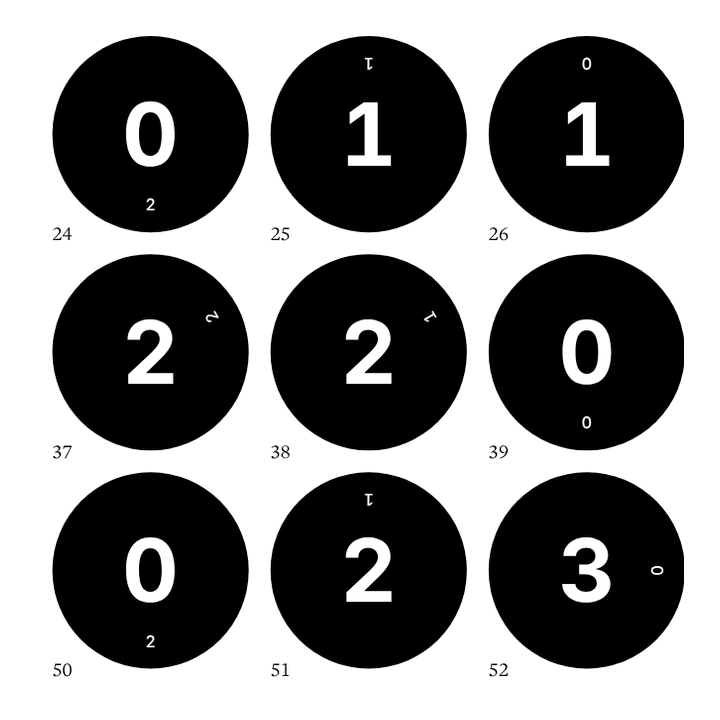
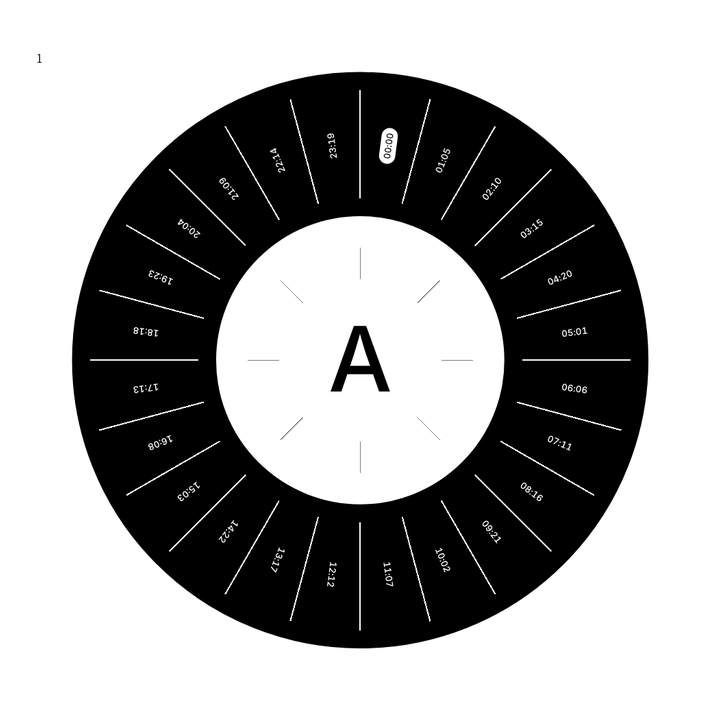
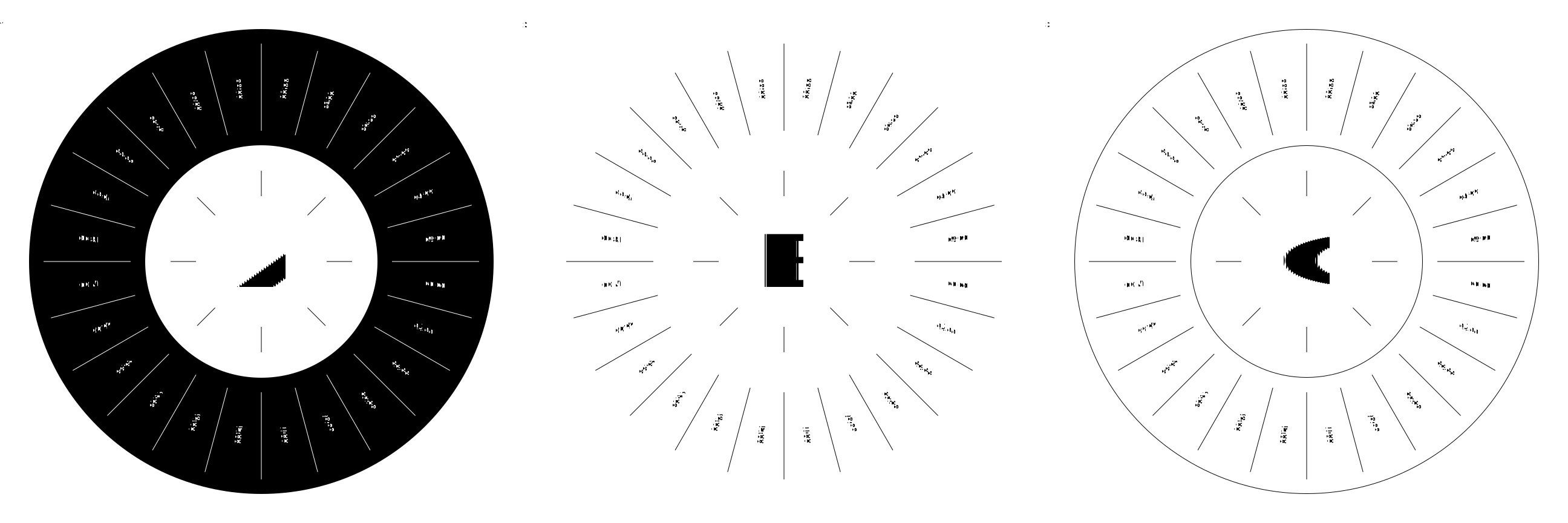
Three dials, A, B and C, each a ring of twenty four stations fifteen degrees apart. Once a second every dial turns by a whole number of stations and holds: A by 1, B by −2, C by 3, positive clockwise. After t seconds dial ω has turned m = ωt stations, counted modulo 24. A dial returns home after 24 / gcd(ω, 24) seconds, 24, 12 and 8, so all three stand at the start together only every 24 seconds.
The labels do not turn. The label at place p prints p, a colon and p × m modulo 24, so each ring writes out the times table of its own position. Every second all twenty four products on every dial change at once; the places never do. When m shares no factor with 24 the ring holds every number from 00 to 23 exactly once, shuffled. When gcd(m, 24) = d, only 24 / d different values appear, each d times, and exactly d products read 00, evenly spaced round the ring. When the dial is home every product is 00.
The zeros are set on discs, so the factors of m can be read off the ring at a glance: three zeros mean 3 divides m, eight mean 8 does. The hub carries only the dial's letter; everything the dial computes is written on its ring.
Irates and directions Dial A turns 1 station per second, B −2 and C 3, one station being 15°; positive is clockwise. After t seconds a dial has turned m = ωt stations, and only m mod 24 matters, because 24 stations make a full turn.1 A dial comes home after 24 / gcd(ω, 24) seconds: 24 for A, 12 for B and 8 for C. All three are home together only every lcm(24, 12, 8) = 24 seconds.
IIwhere a dial can stand A dial of rate ω only ever brings the multiples of gcd(ω, 24) to the top. A, with a rate coprime to 24, reaches all 24 positions; B reaches 12, the even ones, and C 8, every third.2 So the three dials show three subgroups of the clock of 24: the whole clock, half of it and a third of it.
IIIa times table on every ring The lines turn, the labels stay in their places. The label at place p prints its place, a colon and p · m mod 24, so each ring is the multiplication table of m modulo 24, written round a circle. Every second all 24 labels of every dial change at once.3 If gcd(m, 24) = d, the ring shows only 24 / d different values, each d times, and exactly d products read 00, evenly spaced. When m is 1, 5, 7, 11, 13, 17, 19 or 23 every number from 00 to 23 appears once, shuffled; when m = 12 the ring alternates 00 and 12; when the dial is home every product is 00. The zero products are set on pills, so the divisors of m can be read off the ring.
IVthe zeros Each dial carries only its letter at the centre; everything else is on the ring. The number of labels that read 00 is gcd(m, 24), so a ring with one zero sits at a position coprime to 24 and a ring of zeros is home.4 Read across a row, the counts of zeros are the greatest common divisors gcd(ωt mod 24, 24) of three multiples of the same t.
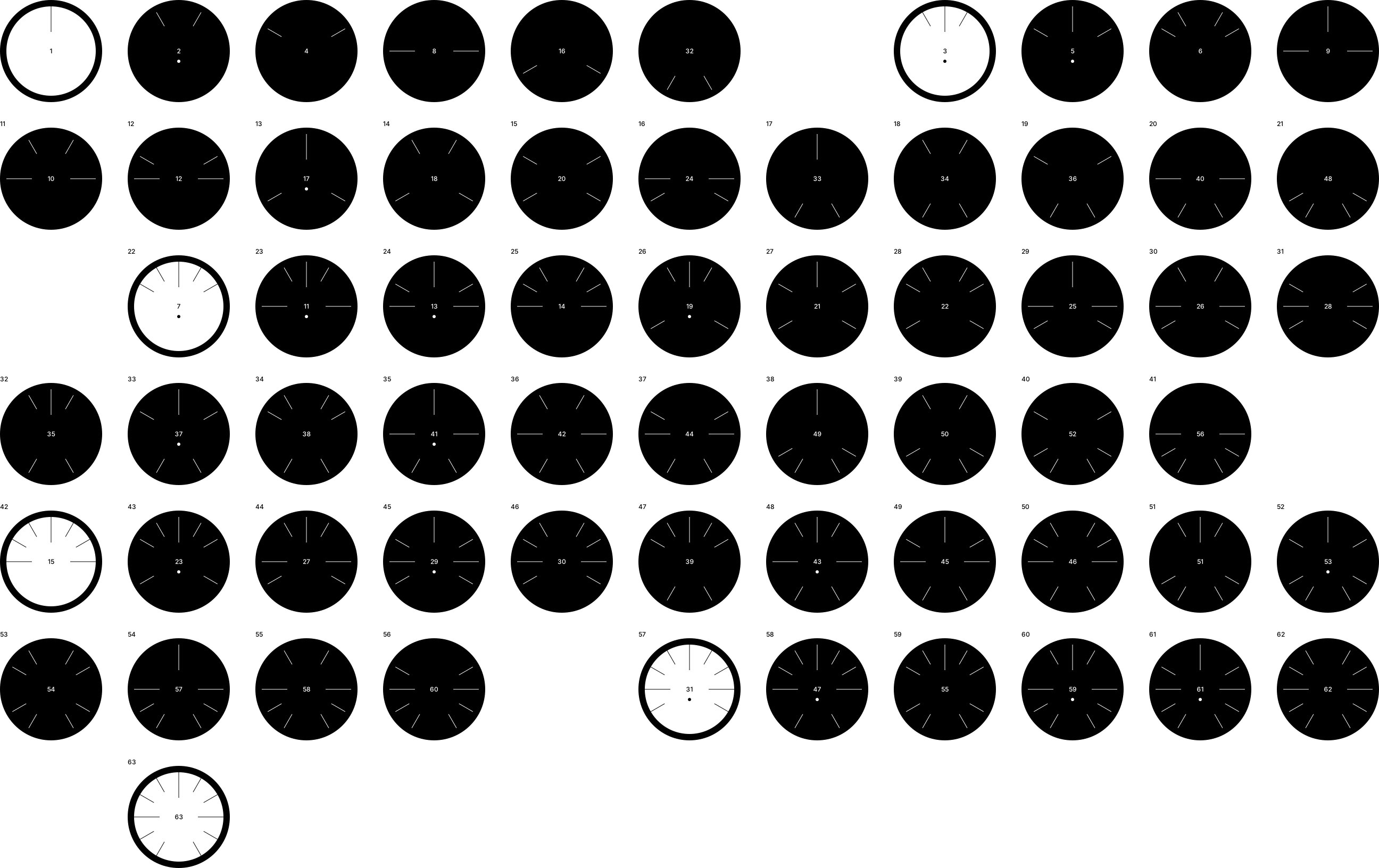
The numbers 1 to 63, every number that six binary digits can write, each on its own disc. All of them stand at once, sorted into six families by how many ones they carry: 6 numbers with one 1, 15 with two, 20 with three, 15 with four, 6 with five and 63 alone with six. The family sizes are C(6, k), row six of Pascal's triangle.
Every disc shows its bits round the rim: twelve stations, and a tick at station s when bit min(s, 12 − s) is one, so bit 0 sits at the top and bits 1 to 5 appear twice, mirrored left and right. Once a second every disc rotates its six bits by one place. The ticks move, some stations go dark and others light, and the number in the centre becomes a new number with the same count of ones: 3 = 000011 becomes 6, 12, 24, 48, 33 and then 3 again. No disc ever leaves its family. Numbers whose bits repeat return sooner: 21 = 010101 alternates with 42 every second, and 63 never changes.
In every family one disc is lit, and the light steps to the next disc once a second. The families have 6, 15, 20, 15, 6 and 1 members, so the lights meet in their opening places only every lcm = 60 seconds, and since the rotation has period 6 the whole plate repeats exactly once a minute. When the number a disc holds is prime, a dot stands beneath it; as the bits turn, the primes wander across the plate.
Ifamilies Six bits give the numbers 1 to 63. Sorted by how many of their bits are one they fall into six families of C(6, k) = 6, 15, 20, 15, 6 and 1, row six of Pascal's triangle without its first 1. The families follow each other in reading order, smallest number first, with one empty place between two families.1 All 63 numbers are on the plate at all times. Nothing arrives and nothing leaves; what changes is which number each disc holds.
IIbits on a dial Each disc has twelve stations, every 30°. Station s carries a tick when bit min(s, 12 − s) of the disc's value is one: bit 0 is the top, bits 1 to 5 appear twice, once on each side, and the bottom station is always empty. So every dial is mirror symmetric and can be read back into its number.2 Once a second every disc rotates its six bits by one place, the top bit carried round to the bottom: v = rot(n, t mod 6). Ticks move, appear and vanish, and the number in the centre changes, but the count of ones stays, so no disc ever leaves its family. Most return to their first number after six seconds; 21 and 42 after two; 9, 18, 27, 36, 45 and 54 after three; 63 never changes.
IIIthe light In every family exactly one disc is lit, and each second the light moves to the next disc of its family, wrapping at the end. The six families have periods 6, 15, 20, 15, 6 and 1, so the lights stand in their opening places together only every lcm(6, 15, 20) = 60 seconds. The single disc 63 is its own family and is always lit.3 The bit rotation has period 6, which divides 60, so the whole plate, lights and numbers, repeats exactly once a minute.
IVprimes The centre prints the number the disc holds at this second, with a dot beneath it when that number is prime. There are 18 primes below 64, and since the rotation changes every number, the primes wander: a disc holding 3 = 000011 holds 6, 12, 24, 48 and 33 in the next five seconds, none of them prime.4 The live readings print the lit number of every family in decimal and in binary, and how many primes stand on the plate.
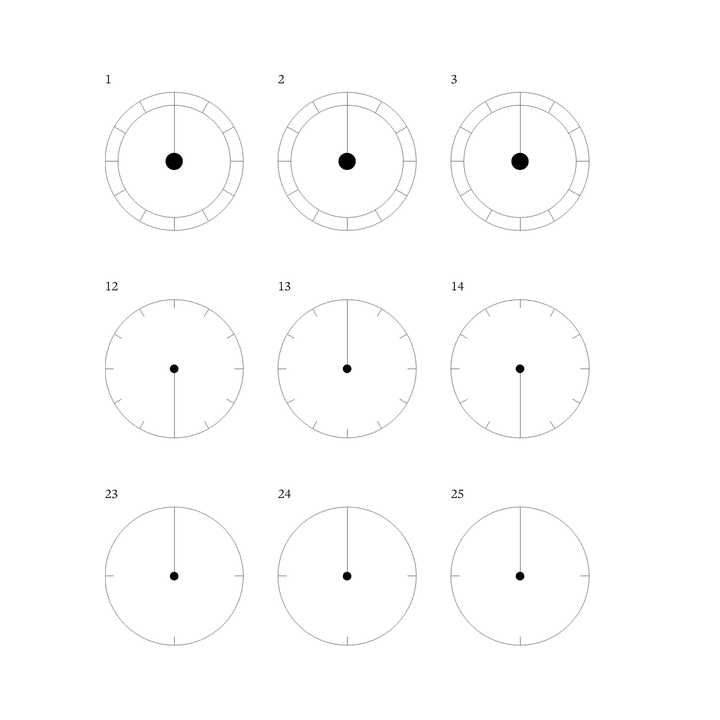
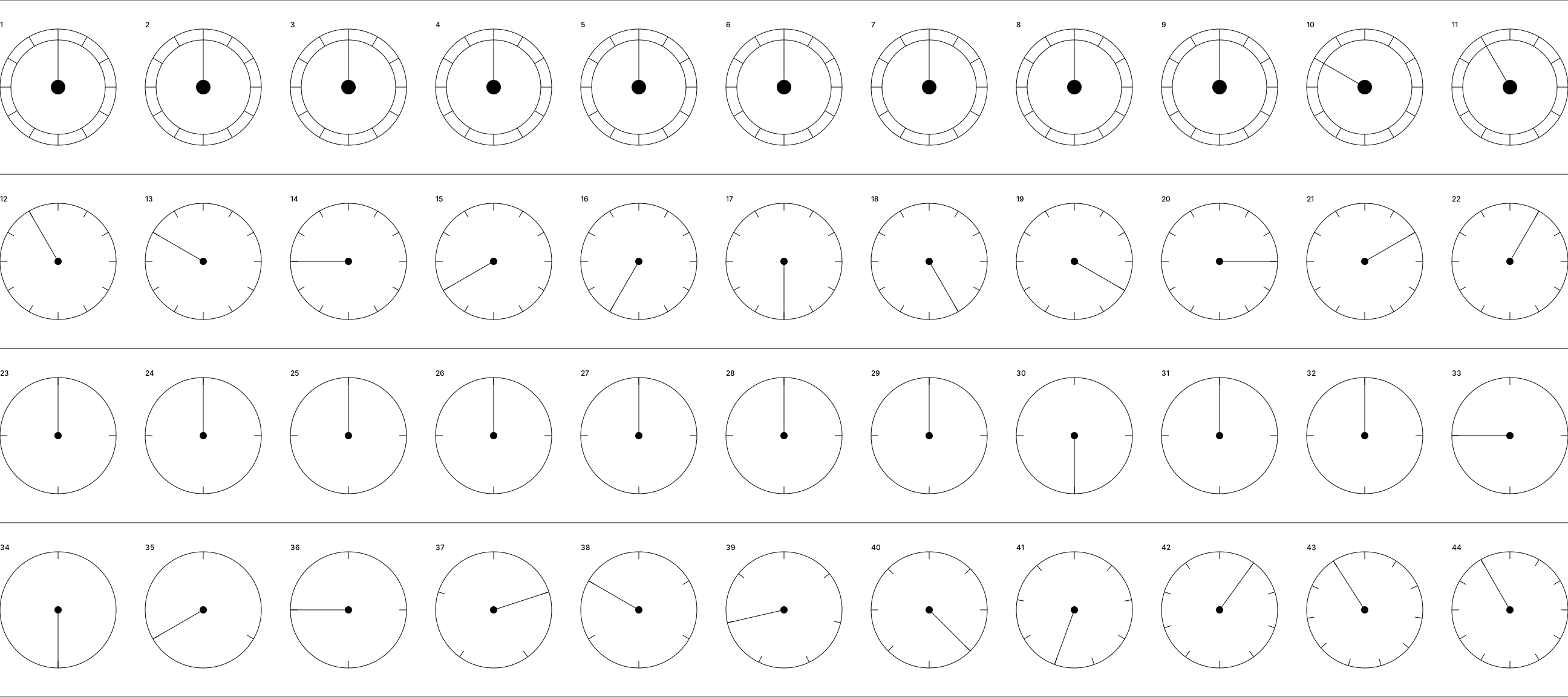
A hand on a dial of n stations holds one number from 0 to n − 1. Forty four of them, in four rows, read the same second four ways: t in base twelve, eleven rates of turning, t in base four, and eleven divisions of the circle from 2 to 12. Together the rows show positional notation, multiplication modulo 12 and the least common multiple at work on one clock.
Ione hand A dial of n stations can hold exactly n values, 0 to n − 1, and a hand has nothing to read but its direction. Eleven dials side by side can therefore hold a number of eleven digits, or eleven separate remainders, depending on how they are tied together.1 The four rows tie them in four ways: as digits of one number, as multiples of one step, as digits again with a smaller base, and as remainders by eleven different moduli.
IIcounters The first and third rows are odometers. The first writes t in base twelve, one digit per dial, units on the right; t = Σ dᵢ · 12ⁱ, so eleven dials can count to 12¹¹ − 1. The third writes t in base four, so each hand only ever points up, right, down or left.2 Reading from the right, the dials turn every second, every twelve, every hundred and forty four; in the quarter row every second, every four, every sixteen. The left dials of both rows will not move in a lifetime.
IIIrates In the second row dial k turns k stations per second on twelve stations. Dials 1, 5, 7 and 11 are coprime to twelve and visit every station; dial 6 only flips between noon and six; dial 4 draws a triangle and dial 3 a square.3 Whatever the rate, after twelve seconds every hand is back at noon, so the row closes into a straight line of vertical hands once every twelve seconds.
IVdivisions In the fourth row dial k divides its circle into k + 1 stations, from 2 to 12, and the ticks show where. Each hand takes one step a second. Two neighbours share noon every n(n + 1) seconds, and the whole row only at the least common multiple of 2 to 12, 27 720 seconds, seven hours and forty two minutes.4 The readings under the plate print t, the digits of both counters, the hands of the rates and the seconds to the next full meeting.
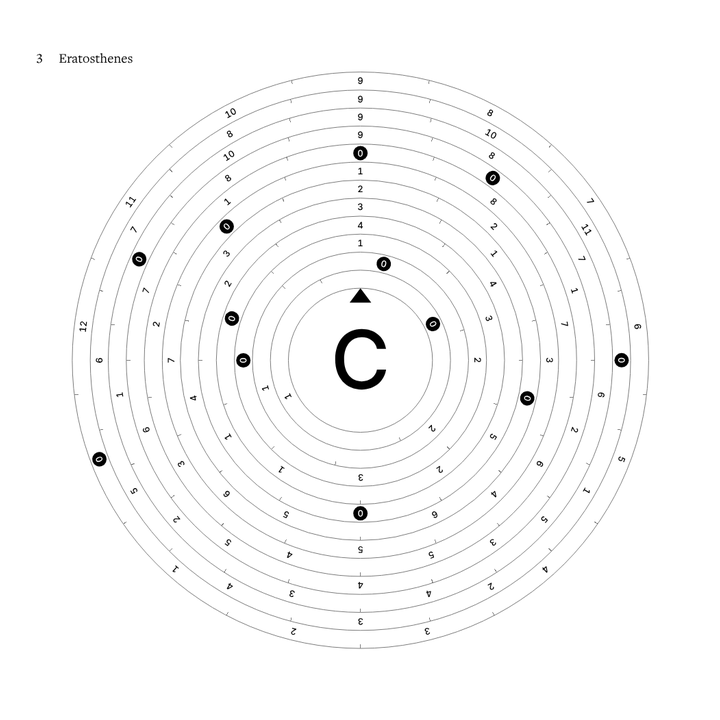
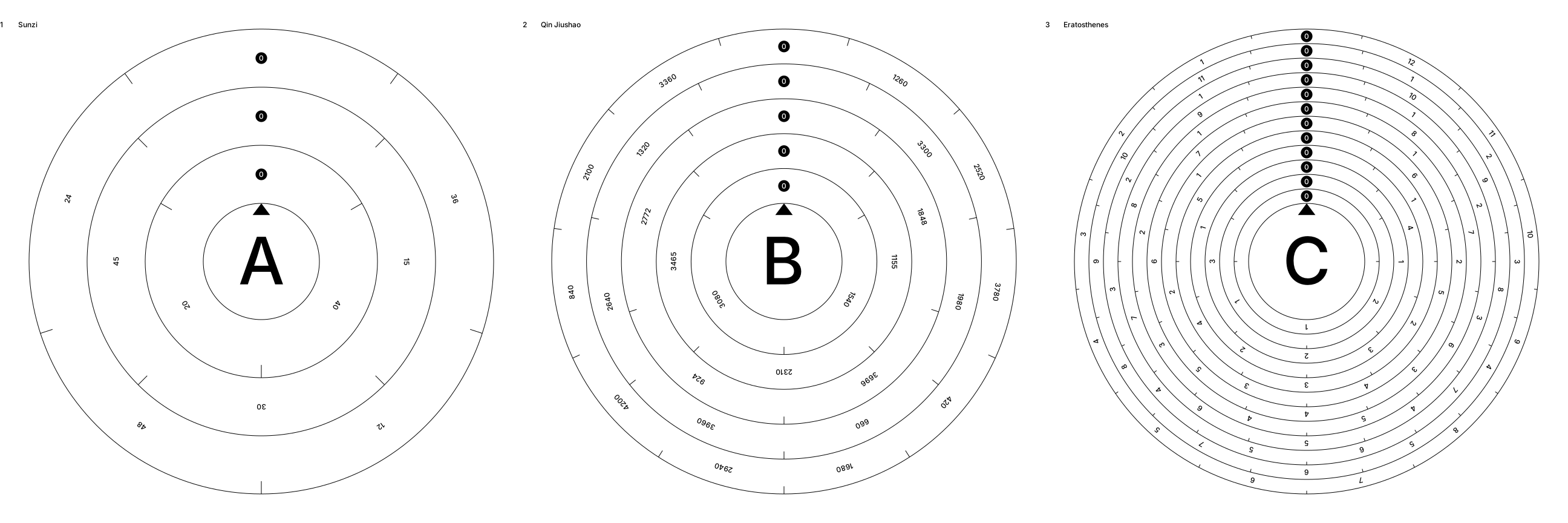
Concentric rings of numbers turn round a fixed notch, each ring by its own step and direction. On dials A and B, named after Sunzi and Qin Jiushao who first wrote down the Chinese remainder theorem, the numbers are placed so that whatever stands at the notch adds up to the count: three rings count to 60, five to 4620. Dial C, after Eratosthenes, has twelve rings of 2 to 13 stations, and the zeros that line up at its notch sieve out the divisors of the count.
Irings round a notch Each dial has a notch at the top where it is read, and concentric rings round it. Ring m has m stations, each carrying a number. Every three seconds the count n goes up by one and every ring turns k stations, some clockwise and some against. k is always coprime to m, so every station of the ring reaches the notch exactly once in m counts.1 The rings follow one after another from the centre outwards, so a single count can be watched travelling through the dial.
IInumbers that add up to the count On dial A the rings have 3, 4 and 5 stations, coprime to each other. A ring turning k stations a step brings station j to the notch when n ≡ j / k modulo m, so station j carries that residue times e, where e is 1 modulo m and 0 modulo the other rings: 40, 45, 36. By the Chinese remainder theorem, known from Sunzi's manual and made general by Qin Jiushao, the labels at the notch add up to n modulo 60. Dial B does the same with 3, 4, 5, 7 and 11 at speeds 2, −3, 2, −3 and 4, and counts to 4620.2 So the rings read like a meter: 20 and 45 and 36 at the notch make 101, which is 41 modulo 60, however the rings happen to be turning.
IIIzeros that line up Dial C has twelve rings of 2 to 13 stations, labelled with their residues. Every zero is marked. At the notch ring m shows n mod m, so a zero there means that m divides n, and the zeros that stack up at the notch are the divisors of n, a sieve in the manner of Eratosthenes. The rings turn in alternate directions, so between the notch and the rim the zeros run apart and close again. At n = 60 seven rings show zero at once, 2, 3, 4, 5, 6, 10 and 12; all twelve agree only at n = 360 360.3 The inner rings return quickly and the outer ones slowly, so away from the notch the zeros scatter round the dial and gather again whenever n has many divisors.
IVcomplexity The three dials grow in the number of rings and in their period: lcm(3, 4, 5) = 60 counts for three rings, 4620 for five and lcm(2, …, 13) = 360 360 for twelve, twelve and a half days at one count every three seconds.4 The live readings print the labels at each notch, their sum, and the divisors of n.
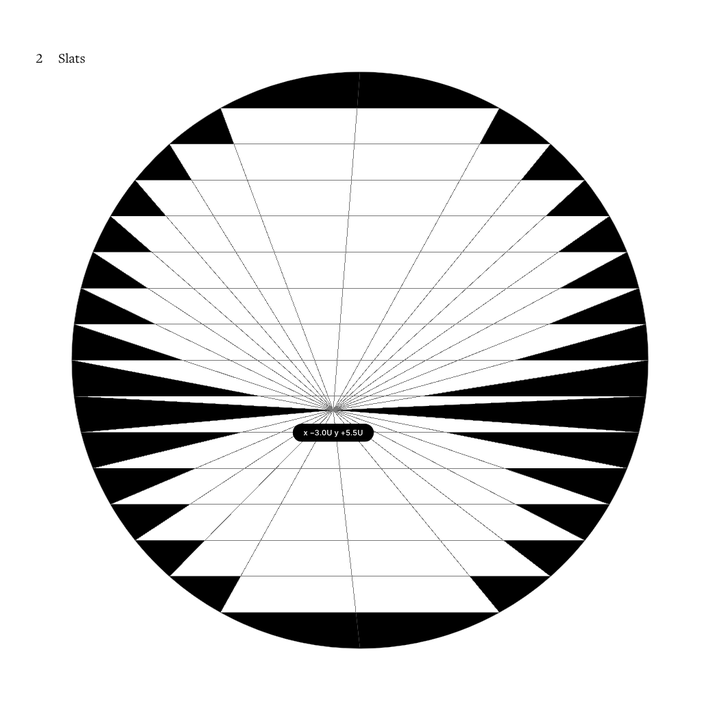
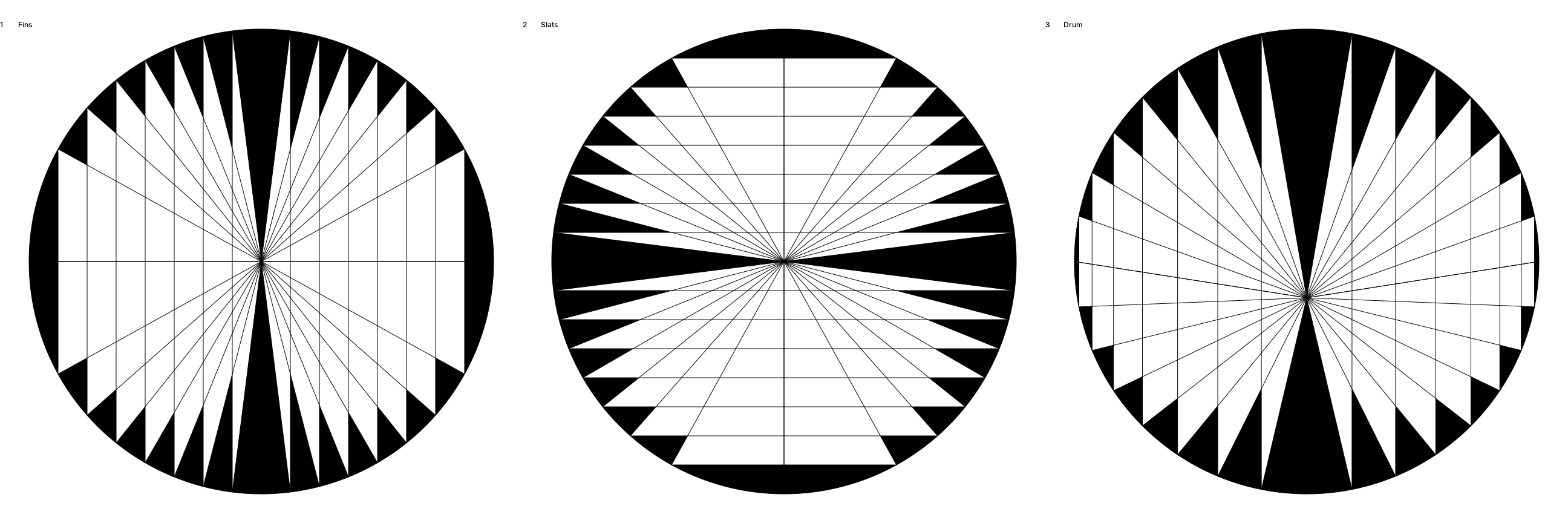
A circle of radius 32 is cut by seventeen fixed chords. Each chord is read as the near edge of a plane running back to one vanishing point, and every ray and every hidden region is computed from that point. Three arrangements: chords at equal steps x = 4k, the same turned through 90°, and chords at x = 32 · sin(k · 11.25°), the projection of equal angles round a cylinder. Once a second the vanishing point moves along a sine path; the chords never change, yet the whole space appears to turn.
Ia chord as the edge of a plane Every vertical chord of the circle is taken as the near edge of a plane that stands edge on to the viewer and runs straight back. In central perspective all its other edges meet at the vanishing point, so the top and the bottom of the plane are rays from that point through the ends of the chord.1 Between two neighbouring planes, the outer one hides everything behind it below its top ray. What it cannot hide, between its ray, the rim and the inner plane, is the hidden region, and it is filled.
IIthree arrangements Fins places seventeen chords at x = 4k, k = −8 … 8, equal steps of an eighth of the radius. Slats turns the same set through 90°, so the planes are horizontal. Drum places them at x = 32 · sin(k · 11.25°): planes at equal angles round a cylinder, seen end on, so their spacing is the cosine of the angle, wide in the middle and crowded at the rim.2 In the strip that holds the vanishing point both neighbouring planes face away from it, so there the hidden region is a single wedge that runs into the point itself.
IIIa moving eye The vanishing point moves a few units around the centre along sine paths with periods of 28 to 44 seconds, one step a second. Every wedge is recomputed from it, so the hidden regions grow on one side and shrink on the other while the planes appear to swing.3 In Drum the point goes round the centre once in 36 s, so the cylinder seems to rotate although none of its chords move.
IVreading the plate The position of each vanishing point is printed beside it, and with the grid on its every step can be read off a lattice of one unit.4 The figure works because the eye insists on one consistent space: a chord, a ray and the rim are enough for it to see depth.
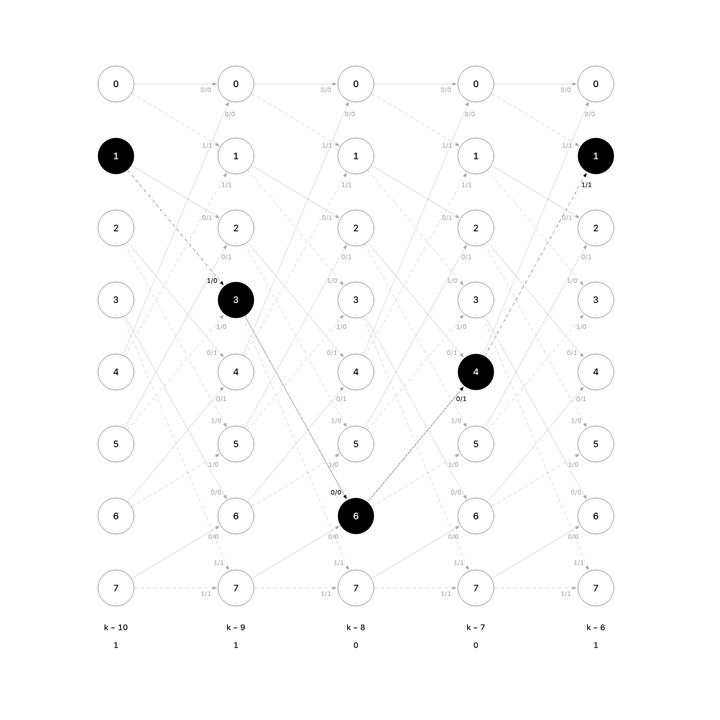
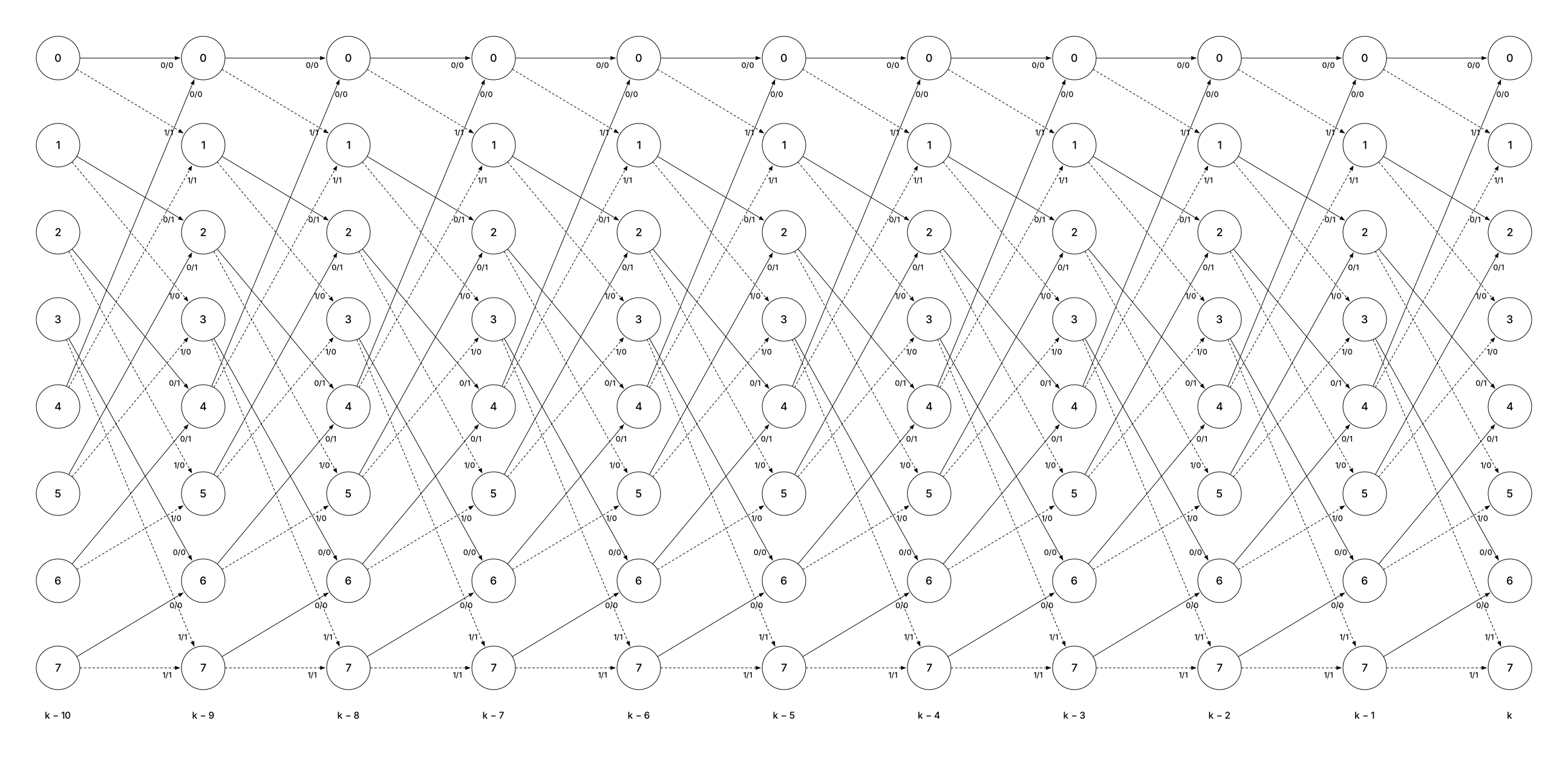
Eleven columns of eight circles hold the numbers 0 to 7, one column per step. From every number two arrows lead to the next column: to twice the number, or twice the number plus one, counted modulo 8. That is all reading a binary number ever does, double and add a digit, so any stream of bits becomes a path through the lattice. The stream here is the Thue–Morse sequence, and its path moves across the plate one bit every two seconds.
Ia lattice of states Eight states, 0 to 7, are the eight possible windows of the last three bits read. Eleven columns repeat them for eleven consecutive steps, k − 10 on the left to k on the right, so the plate holds 88 states and 160 arrows.1 The drawing is a trellis, the diagram engineers use for shift registers and convolutional codes: time runs to the right, and every arrow is one possible step.
IIdouble and add From state s the arrows go to 2s mod 8 and 2s + 1 mod 8. In binary this shifts the three bits one place to the left, drops the oldest and appends the new one. Solid arrows append 0, dashed arrows append 1. The arrows from 0 and 4 meet at 0 and 1, those from 1 and 5 at 2 and 3, and so on, so the lattice crosses itself in a regular weave.2 Each arrow is labelled b / p: the bit appended and the parity of the state it reaches.
IIIa path through it A stream of bits picks one arrow out of every pair. The Thue–Morse sequence, where bit n is the parity of the number of ones in n, never repeats a block three times in a row, so its path wanders over all eight states without settling into a loop.3 Every two seconds the next bit arrives on the right and the whole path moves one column to the left, so the plate always shows the last eleven steps.
IVreading the plate The states on the path, from left to right, spell the last eleven windows of three bits. The live readings print the stream, the current state, and the sum of the states on the path.4 All the other arrows stay in place, so the path that was taken always reads against the 2¹⁰ paths that could have been taken from the same first state.
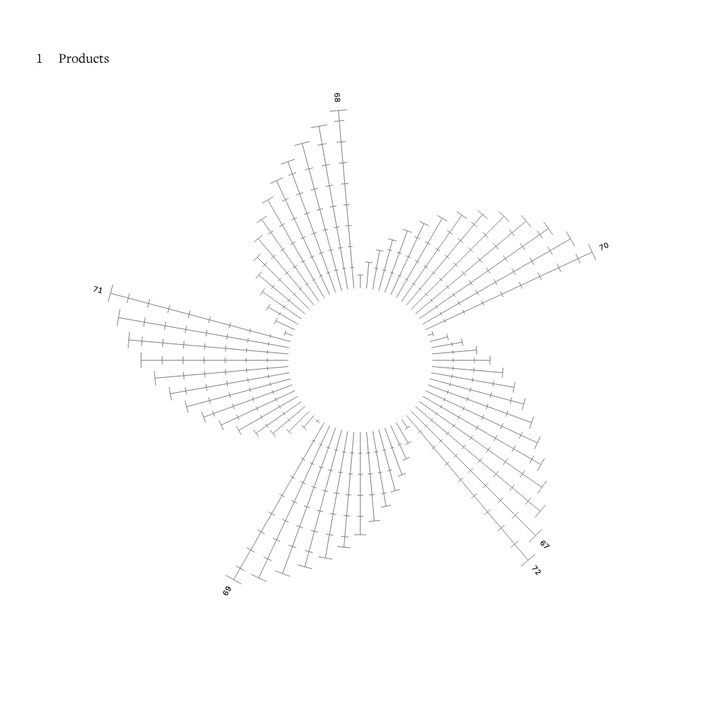
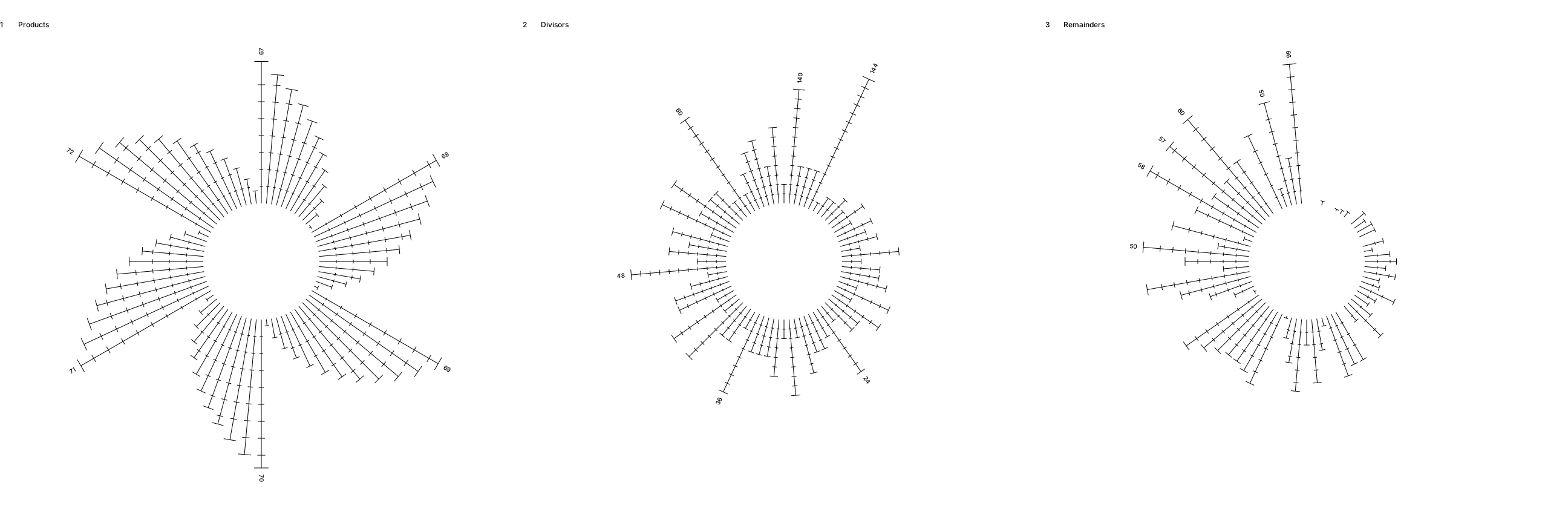
Three suns of 72 rays, five degrees apart. The length of every ray is a number and the ticks across it count it out. The first sun writes the multiplication table modulo the prime 73, a new permutation of 1 to 72 each second; the second counts the divisors of 72 consecutive numbers; the third makes every ray a clock of its own size, so the empty rays mark the divisors of the time.
Ilengths as numbers Each ray starts on an inner circle of a quarter of the radius and runs outwards to at most 29/32 of it; the outer band up to the rim is kept for the numbers, which never cross it. Its length is a whole number of units, and ticks across the ray mark every 8th unit on the first sun, every unit on the second and every 6th on the third, with a longer bar at the end; the six longest rays of each sun print their number beyond it, the length on the first and third sun and n itself on the second. Ticks span a fixed angle, so they widen with the radius and the ticks of neighbouring rays never meet. A tick that would fall closer than half a step to the end is left out, so every gap along a ray is between half a step and a step and a half. A ray can therefore be read like a ruler.1 Rays are numbered k = 0 … 71 from the top, clockwise. The time enters as c = 33:30 + t, the same clock as everywhere in the series.
IIa permutation every second On the first sun ray k has length (k + 1) · m mod 73 with m = 1 + (c mod 72). Because 73 is prime and m is never a multiple of it, the map k → k · m is a bijection: the 72 rays always carry the 72 lengths 1 to 72, each once, only in a different order.2 For m = 1 the lengths grow steadily round the circle, a spiral; m = 72 ≡ −1 is the same spiral running the other way; m = 2 winds it twice; m = 27 has 27² = 729 ≡ −1 modulo 73, so applying it twice gives the reversed spiral.
IIIdivisors in a window On the second sun ray k shows n = 1 + ((k + c) mod 144) and has length d(n), the number of divisors of n, one tick per divisor. Primes have exactly two divisors, so every prime is a short ray of two ticks; 1 is a single tick; 120 has sixteen divisors and 144 fifteen.3 Each second the window of 72 numbers slides by one, so the whole sun turns one ray anticlockwise and one new number enters at the top.
IVevery ray a clock On the third sun ray k has length c mod (k + 1). Each ray grows by one unit a second until it reaches k and then falls back to zero, so ray 0 is always empty, ray 1 blinks, and ray 71 takes 72 seconds to go round. The rays that are empty together are exactly those with k + 1 dividing c, so the gaps in the sun print the divisors of the time.4 The whole third sun returns to an earlier state only after lcm(1, …, 72) seconds, a number of 31 digits.
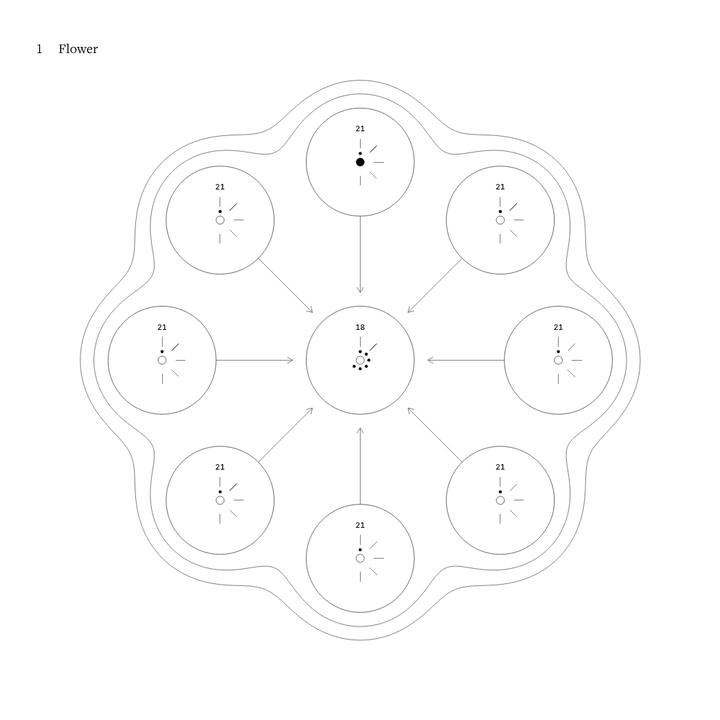
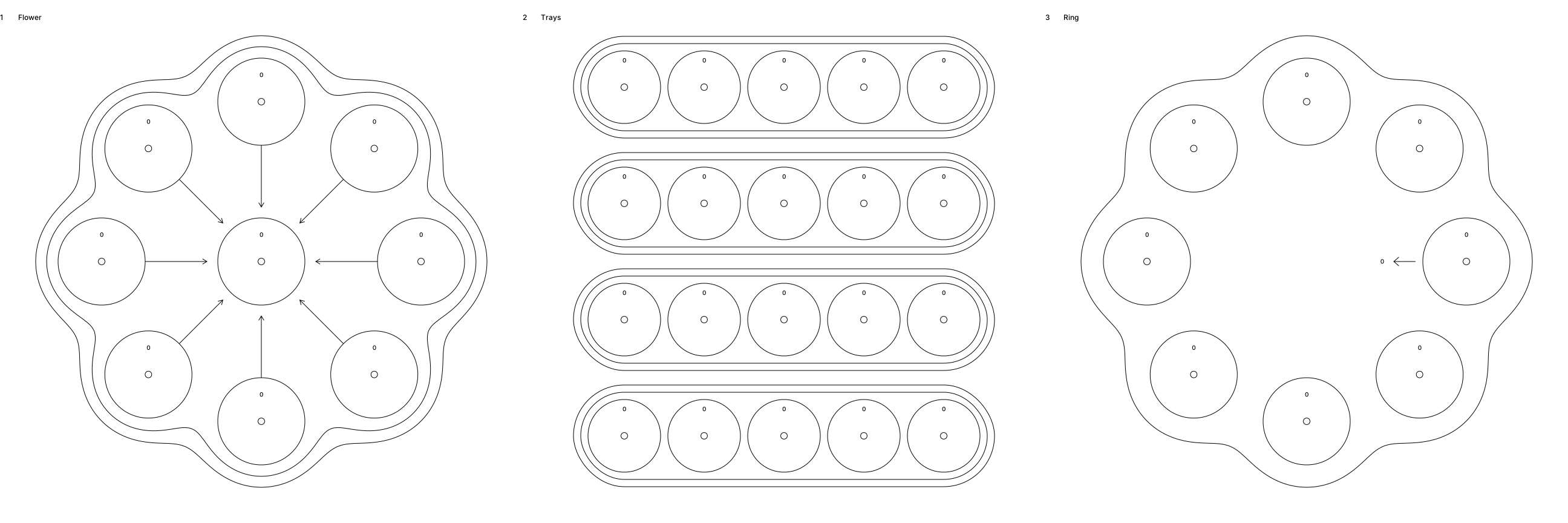
A sandpile, counted. Every disc holds at most as many grains as it has neighbours. One more and it topples: it gives one grain to each neighbour and loses one, which falls out of the figure. A topple can fill a neighbour, which topples in turn, so one grain can set off an avalanche; but every topple loses a grain, so every avalanche stops. Once a second a grain falls on each figure, always at the same rule's place, and after a short beginning each figure settles into a cycle it repeats for ever: 80 seconds for the flower, 55, 55, 11 and 5 for the trays, 105 for the ring.
Ithe rule Each figure is a graph: discs are vertices, neighbours share an edge. A disc v with deg(v) neighbours is stable while it holds at most deg(v) grains. With deg(v) + 1 it topples: deg(v) grains go one to each neighbour and the last one leaves. A leaf of the flower has one neighbour and holds one grain, the centre has eight and holds eight, a disc inside a tray has two, a disc at the end of a tray one, every disc of the ring two.1 Because a topple always loses a grain, the number of grains on a figure can only stay level for a while; an avalanche cannot run for ever. The order in which unstable discs topple does not change the result, which is why the sandpile is called abelian: the plate topples all of them at once and repeats until none is left.
IIa cycle for every figure After the first grains have filled the empty figure, it reaches states it will return to, the recurrent states. Adding a grain at a fixed place and toppling is an addition in the sandpile group of the figure, which has det(Δ + I) elements, where Δ is the graph Laplacian: 1280 for the flower, 55 for a tray and 2205 for the ring.2 The period is the order of the added grain in that group. A grain at the end of a tray or next to it has order 55 and walks through every recurrent state; a grain in the middle has order 11, because the tray is symmetric about it. A tray fed on its five discs in turn adds one grain to every disc each five seconds, and its period is 5.
IIIthe flower and the ring The flower is fed on its leaves in turn, clockwise from the top. A leaf that already holds a grain topples at once, so every second leaf grain goes into the centre; the centre fills to eight and on the ninth sends one grain down each spoke, which can topple several leaves at once. The largest avalanche on the flower is nine topples in one second, the period 80 s, reached after 7 s.3 The ring is fed on its top disc. Grains spread both ways round it in waves; the whole ring repeats every 105 s = 3 · 5 · 7, after 29 s of filling, and its largest avalanche is eight topples, one for every disc.
IVcounting the grains Six grains fall every second. Each one is at every moment either on a disc or gone, and a grain is gone only by the last share of a topple, so after t seconds 6t = held + lost exactly. The number at the ring's arrow counts its lost grains, and the arrow steps one station anticlockwise for each, so it stands at station −lost mod 8; the topple counts above the discs add up to the lost grains of each figure.4 In a cycle the figure neither gains nor loses on balance: over one period it loses exactly as many grains as fall on it, one a second.
| metric | Orbits (n=18) | Chords (n=9) | Capsules (n=23) | Places (n=78) | Punch (n=13) | Dials (n=3) | Discs (n=63) |
|---|---|---|---|---|---|---|---|
| figures | 18 | 9 | 23 | 6 rows | 13 rows | 3 | 63 |
| step | 1 s | 1 s | 1 s | 1 s | 1 s | 1 s | 1 s |
| shortest period | 2 s | 10 s | 3 s | 60 s | 48 s | 8 s | 6 s |
| longest period | 26 s | 60 s | 144 s | 60 s | 48 s | 24 s | 60 s |
| modulus | 24 | 6 to 96 | 3 to 144 | 2 to 16 | 32 | 24 | 64 |
| rule | station k ± t mod 24 | k → k·m mod n | f(t), 23 functions | F(n + 1) = F(n) + F(n − 1) | x = (2j + 1) · 216 / 2ᴸ⁺¹ | p · m mod 24 | rot(n, t mod 6) |
| largest value | 24 stations | 630 chords | 6174 | F(54) | 216 cells | 23 | 63 |
| live values | 18 | 9 | 23 | 6 | 3 | 5 | 4 |
| plate width | 362U | 216U | 256U | 258U | 216U | 216U | 216U |
| plate height | 366U | 216U | 294U | 121U | 104U | 72U | 138U |
| height / width | 1.01 | 1.00 | 1.15 | 0.47 | 0.48 | 0.33 | 0.64 |
| drawn elements | 2 164 | 662 | 1 620 | 1 022 | 316 | 647 | 1 532 |
| circles | 527 | 45 | 258 | 312 | 0 | 27 | 144 |
| lines | 1 158 | 490 | 1 149 | 475 | 269 | 460 | 1 198 |
| paths | 0 | 18 | 1 | 0 | 13 | 0 | 0 |
| rectangles | 0 | 18 | 67 | 0 | 0 | 75 | 0 |
| groups | 37 | 28 | 19 | 1 | 2 | 7 | 64 |
| printed values | 420 | 45 | 78 | 84 | 19 | 75 | 63 |
| numerals | 420 | 0 | 30 | 84 | 0 | 0 | 63 |
| distinct numerals | 24 | 0 | 14 | 13 | 0 | 0 | 63 |
| changes per second | 6 908 | 81 | 41 097 | 28 088 | 512 | 396 | 1 028 |
| ink min / mean / max % | 27.7 / 29.7 / 31.1 | 0.2 / 0.2 / 0.2 | 27.8 / 28.1 / 28.3 | 52.5 / 52.8 / 53.1 | 32.0 / 35.7 / 39.8 | 16.0 / 16.3 / 16.8 | 39.3 / 39.3 / 39.3 |
| grid lines | 1 248 | 535 | 879 | 631 | 269 | 379 | 909 |
| table rows | 6 | 6 | 6 | 6 | 6 | 6 | 6 |
| words in lead | 284 | 374 | 265 | 349 | 262 | 229 | 265 |
| words in notes | 792 | 427 | 1 038 | 257 | 148 | 224 | 216 |
| equations in notes | 26 | 28 | 45 | 7 | 3 | 5 | 2 |
| live characters | 184 | 175 | 252 | 42 | 82 | 113 | 103 |
| chapters | 4 | 4 | 4 | 4 | 4 | 4 | 4 |
| words in chapters | 427 | 361 | 320 | 337 | 410 | 356 | 397 |
| footnotes | 4 | 4 | 4 | 4 | 4 | 4 | 4 |
| page size KB | 105 | 80 | 83 | 51 | 23 | 46 | 71 |
| SVG size KB | 85 | 65 | 61 | 38 | 11 | 41 | 66 |
| metric | Hands (n=44) | Rings (n=20) | Planes (n=51) | Trellis (n=88) | Rays (n=216) | Grains (n=37) |
|---|---|---|---|---|---|---|
| figures | 44 | 3 dials | 3 | 11 columns | 3 | 37 discs |
| step | 1 s | 3 s | 1 s | 2 s | 1 s | 1 s |
| shortest period | 12 s | 3 counts | 28 s | – | – | 5 s |
| longest period | 27 720 s | 360 360 counts | 44 s | – | – | 105 s |
| modulus | 2 to 12 | 2 to 13 | – | 8 | 73, 144 | 55, 1280, 2205 |
| rule | t in base 12 and 4 | n mod 60, n mod 4620 | x = 32 · sin(k · 11.25°) | s → 2s + b mod 8 | k · m mod 73 | g(v) > deg(v): topple |
| largest value | 12¹¹ − 1 | 4619 | 34 rays | 7 | 144 | 14 topples |
| live values | 4 | 4 | 4 | 4 | 3 | 5 |
| plate width | 216U | 216U | 216U | 216U | 216U | 216U |
| plate height | 96U | 72U | 72U | 108U | 72U | 72U |
| height / width | 0.44 | 0.33 | 0.33 | 0.50 | 0.33 | 0.33 |
| drawn elements | 1 422 | 819 | 587 | 1 255 | 368 | 1 071 |
| circles | 198 | 86 | 9 | 88 | 9 | 372 |
| lines | 1 135 | 430 | 451 | 488 | 328 | 596 |
| paths | 0 | 3 | 96 | 160 | 3 | 12 |
| rectangles | 0 | 3 | 3 | 0 | 0 | 8 |
| groups | 45 | 156 | 19 | 249 | 4 | 39 |
| printed values | 0 | 135 | 3 | 270 | 18 | 38 |
| numerals | 0 | 132 | 0 | 99 | 18 | 38 |
| distinct numerals | 0 | 46 | 0 | 8 | 15 | 2 |
| changes per second | 88 | 1 200 | 18 319 | 38 | 57 | 85 020 |
| ink min / mean / max % | 0.3 / 0.3 / 0.3 | 0.6 / 0.6 / 0.6 | 17.1 / 17.2 / 17.2 | 1.3 / 1.3 / 1.4 | 0.0 / 0.0 / 0.0 | 0.0 / 0.0 / 0.0 |
| grid lines | 745 | 318 | 301 | 328 | 337 | 294 |
| table rows | 6 | 6 | 6 | 6 | 6 | 6 |
| words in lead | 71 | 88 | 94 | 82 | 74 | 111 |
| words in notes | 185 | 247 | 224 | 183 | 213 | 267 |
| equations in notes | 6 | 6 | 4 | 3 | 14 | 3 |
| live characters | 125 | 173 | 97 | 100 | 93 | 125 |
| chapters | 4 | 4 | 4 | 4 | 4 | 4 |
| words in chapters | 339 | 436 | 337 | 321 | 501 | 524 |
| footnotes | 4 | 4 | 4 | 4 | 4 | 4 |
| page size KB | 60 | 49 | 32 | 80 | 46 | 96 |
| SVG size KB | 56 | 44 | 28 | 76 | 42 | 90 |